
⚡ Short answer
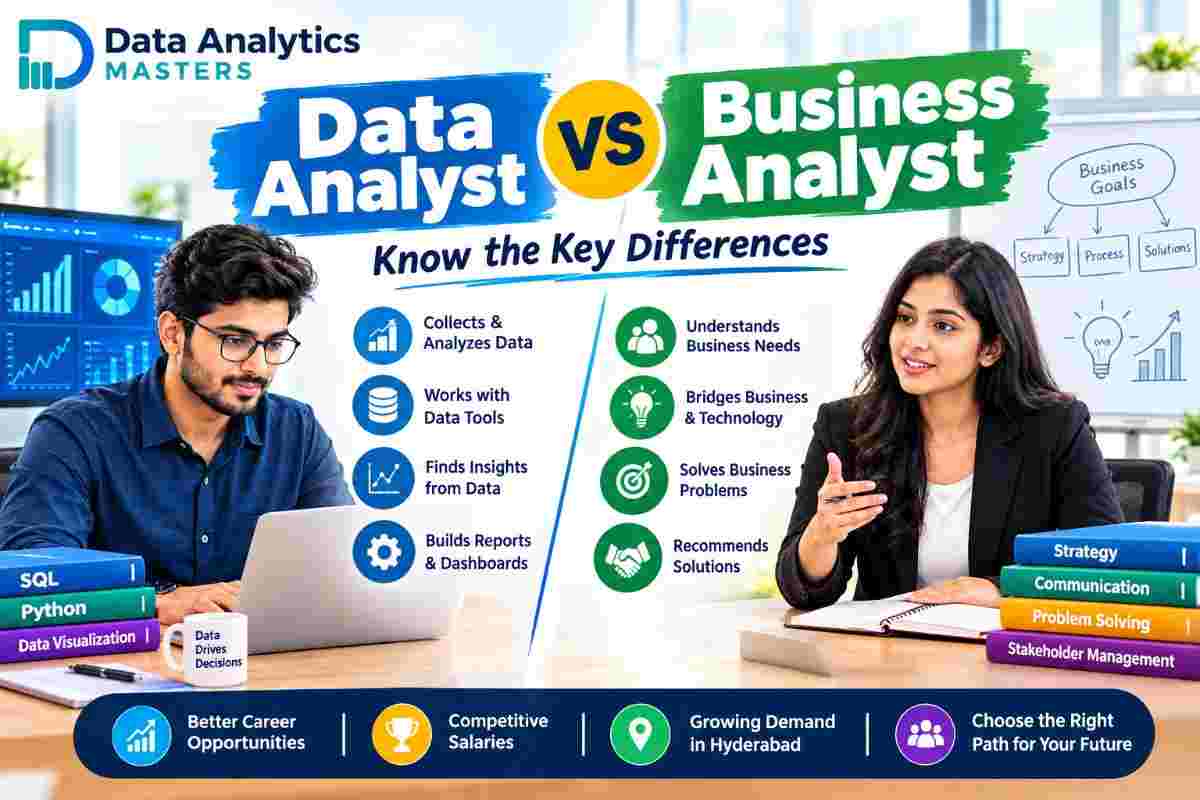
A data analyst investigates what the data reveals, why a particular pattern may be occurring and what the evidence suggests. A business analyst investigates what a business needs, where a process or system can improve and how a proposed solution should work. For example, when a company experiences declining sales, a data analyst may examine revenue by product, location, customer segment and month. A business analyst may interview sales teams, document the problems with the sales process and define requirements for a new customer management system. Both roles can work together to solve the same business problem
The job first
What Is a Data Analyst?
A data analyst collects, validates, analyses and interprets data to answer specific business questions. The role involves working with structured information from databases, spreadsheets, business applications and other sources.
The objective is to turn raw information into reliable findings that stakeholders can use when making decisions.
1. Collecting and validating data from different sources.
2.Identifying missing values, duplicates and inconsistencies.
3.Creating SQL statements to extract, organize, and examine data from databases.
4. Using Excel or Python to investigate patterns and trends.
5.Creating reports and dashboards using Power BI or Tableau.
6.Monitoring key performance indicators (KPIs).
7. Explaining analytical findings and their limitations.
8. Recommending actions supported by evidence.
Example of a data analyst's work
Imagine an online retailer whose monthly revenue has declined.
The data analyst examines transaction records, product categories, customer behaviour, order cancellations and regional performance. The analysis may reveal that revenue declined mainly because repeat purchases fell in two product categories.
The analyst presents the findings in a report or dashboard so the management team can investigate suitable actions.
The exact conclusion depends on the available data; the analyst should not assume a cause before testing the evidence.
What to learn
What Is a Business Analyst?
A business analyst studies business needs, existing workflows and stakeholder expectations to identify improvements. The role often connects business teams with technical teams, helping everyone understand the problem and agree on a practical solution.
Depending on the organization, a business analyst may work on software implementation, process improvement, reporting requirements, operational efficiency or changes to an existing product.
Key responsibilities of a business analyst
1. Meeting stakeholders to understand business problems.
2. Gathering, analyzing and documenting requirements.
3. Mapping existing and proposed business processes.
4. Identifying gaps between current operations and desired outcomes.
5. Preparing business requirement documents or user stories.
6. Coordinating with developers, testers, product teams and managers.
7. Supporting requirement validation and user acceptance testing.
8. Tracking whether an implemented solution meets the agreed needs.
Example of a business analyst's work
Suppose the same retailer receives repeated complaints about delayed orders and customer service teams struggle to track their status.
The business analyst speaks with customer service staff, warehouse teams and managers. They document the existing process, identify communication gaps and define requirements for an order-tracking improvement.
They may work with the technical team to clarify system behavior, establish acceptance criteria and confirm whether the completed solution meets business requirements.
A business analyst does not necessarily develop the software. Their responsibility is to ensure the solution addresses the actual business need.
Comparison
Data Analyst
Business Analyst
Primary focus
Data analysis and evidence
Business needs and solutions
Primary focus
What does the data tell us?
What does the business need to improve?
Typical input
Datasets, database tables and reports
Stakeholder feedback, workflows and requirements
Main activities
Querying, cleaning, analysing and visualising data
Interviews, process mapping and requirement analysis
Common tools
SQL, Excel, Python, Power BI, Tableau
Excel, Jira, Confluence, Visio and diagramming tools
Typical deliverables
Dashboards, analytical reports and KPI summaries
Requirement documents, user stories and process maps
Stakeholder interaction
Explaining findings and metrics
Gathering requirements and coordinating agreement
Technical emphasis
Data querying, analysis and visualisation
Requirements, processes and solution validation
Success measures
Accuracy, useful insights and reporting quality
Requirement clarity, solution fit and process improvement
Common career directions
Senior Data Analyst, BI Analyst, Analytics Specialist
Senior Business Analyst, Product Owner, Business Consultant
These are typical patterns, not strict boundaries. Some data analysts spend considerable time with stakeholders, and some business analysts use SQL, dashboards and advanced data analysis.
Data Analyst vs Business Analyst: A Real-World Example
Consider a healthcare company that wants to reduce missed appointments. Both analysts may contribute to the same initiative, but their work will differ.
The data analyst's contribution
The data analyst examines appointment records, cancellation rates, waiting periods, locations and appointment types. They identify which groups have higher no-show rates and whether those patterns change over time.
Their output could be a dashboard showing appointment trends and the factors associated with missed visits.
The business analyst's contribution
The business analyst investigates how appointments are scheduled, how reminders are sent and how patients cancel or reschedule. They speak with operational teams to understand the workflow and document requirements for improving the booking process.
Their output could be a revised process map, system requirements and acceptance criteria for an appointment-reminder feature.
How the two roles work together
The data analyst provides evidence about where the problem is concentrated. The business analyst uses stakeholder input and process analysis to help define an appropriate solution.
After implementation, the data analyst can measure whether missed appointments decreased, while the business analyst can assess whether the new process meets the agreed requirements.
This collaboration shows why neither role is universally better. Their value depends on the problem the organization needs to solve.
1
SQL and database fundamentals
SQL helps analysts retrieve, filter, join and summarize information stored in databases. Depending on the role, useful concepts include joins, aggregations, subqueries, common table expressions and window functions.
2
Excel and spreadsheet analysis
Excel is useful for validating data, calculating metrics, creating pivot tables and preparing quick reports.
3
Power BI or Tableau
Business intelligence tools help analysts present results through interactive dashboards, visual reports and KPI tracking.
4
Python and statistics
Python can support data cleaning, automation and larger analytical tasks. Statistics helps analysts distinguish meaningful patterns from random variation.
5
Analytical communication
A good analyst can explain the business question, the evidence, the limitations and the practical implications without overwhelming the audience with technical details.
If you want to understand what these skills look like in practice, explore our guide to Data Analytics Projects for Beginners.
Proof of skill
Skills Required for a Business Analyst
Business analysts need strong problem-solving and communication abilities, supported by a clear understanding of business processes.
Requirements gathering
The analyst must ask useful questions, identify stakeholder needs and distinguish the underlying problem from the solution someone initially requests.
Business process modelling
Process diagrams, workflow documentation and gap analysis help teams understand how work currently happens and what needs to change.
Documentation and user stories
Business requirement documents, functional requirements and user stories help communicate expected behaviour to technical teams.
Stakeholder management
Business analysts frequently coordinate with managers, customers, subject-matter experts, developers and testers. They need to clarify disagreements and maintain a shared understanding of the requirements.
Testing and validation
Business analysts may help prepare acceptance criteria, review test scenarios and support user acceptance testing to confirm that a solution satisfies business expectations.
Data literacy
Excel, SQL and reporting knowledge can be valuable, particularly for roles involving operational metrics, business intelligence or data-driven decision-making.
Business analysts do not all need the same technical depth. Requirements vary considerably between process-focused, IT, product and analytics-oriented positions.
Tools Used by Data Analysts and Business Analysts
The tools used in each role depend on the employer, project and industry.
Common data analyst tools
✓ SQL: Retrieves and summarises data from relational databases.
✓ Microsoft Excel: Supports calculations, data checks and reporting.
✓ Power BI: Creates interactive dashboards and business reports.
✓Tableau: Supports data visualisation and analytical storytelling.
✓ Python: Helps with data preparation, automation and analysis.
✓ Jupyter Notebook: Provides an environment for developing and documenting Python analysis.
✓ Microsoft Excel: Supports calculations, data checks and reporting.
✓Jira: Helps teams manage tasks, user stories and project workflows.
✓ Confluence: Supports documentation and collaborative knowledge sharing..
✓Microsoft Visio or similar diagramming tools: Helps document business processes and system workflows.
✓ Microsoft Word and PowerPoint: Used for requirement documents, proposals and stakeholder presentations.
✓ SQL and Power BI: May be used when the role involves data validation, reporting or analytics requirements.
Data Analyst vs Business Analyst: Which Role Requires More Coding?
A data analyst role is generally more likely to require regular SQL queries and may involve Python, depending on the position. SQL is especially useful when the analyst needs to extract and transform information from databases.
A business analyst role is often less coding-intensive, particularly when the main responsibilities involve requirements, process analysis, documentation and stakeholder coordination.
However, this is not a universal rule.
A business analyst working on a data warehouse or business intelligence project may need SQL and data modelling knowledge. A reporting-focused data analyst may use Excel and a BI platform more frequently than Python.
Choose based on the actual work you want to perform, not on the job title alone.
Ranges are indicative market estimates, not offers or guarantees. Actual pay depends on skills, employer and interview performance.
Data Analyst vs Business Analyst: Which Is Better for Freshers?
Both careers can be suitable for freshers, but the better starting point depends on your interests, existing skills and the entry-level vacancies available to you.