
⚡ Short answer
Yes, non-IT graduates regularly become data analysts. The job needs Excel, SQL, a BI tool and business sense, not a computer science degree. With a structured plan most career switchers become job-ready in about 3–6 months, and their domain knowledge often becomes their biggest advantage.
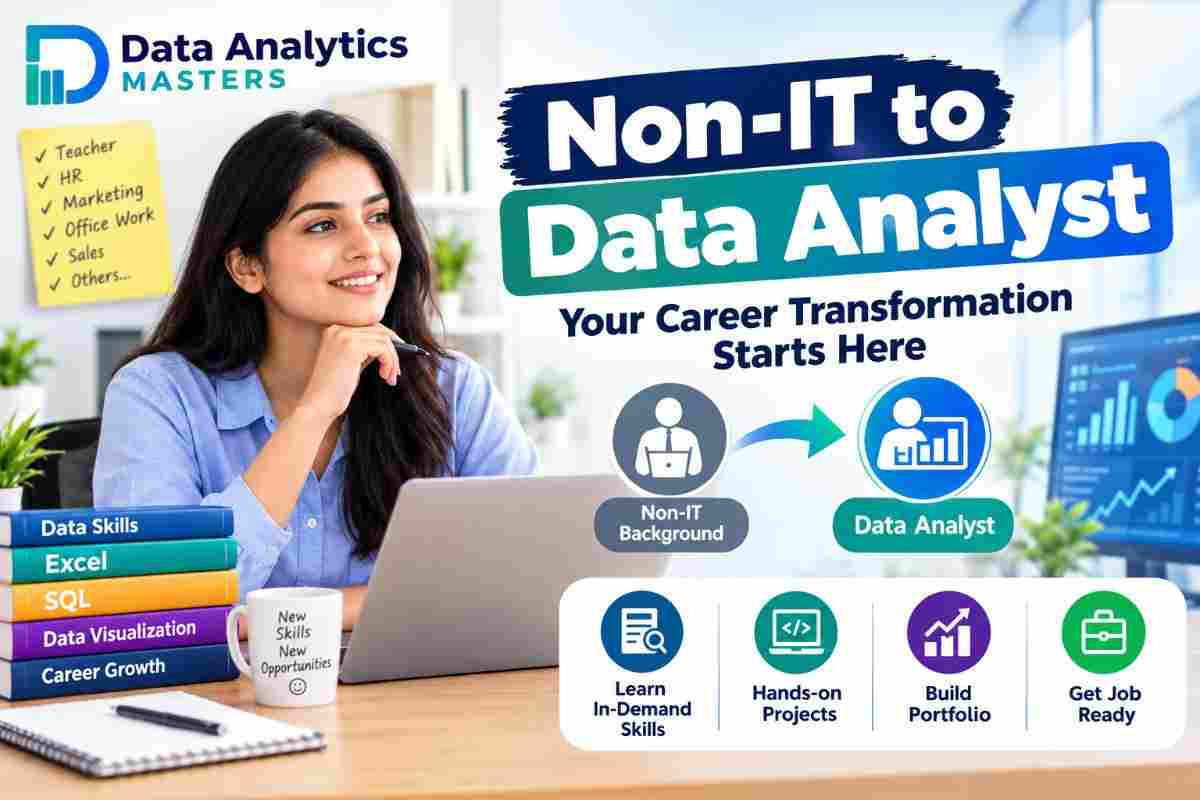
Is it possible?
Non-IT to data analyst: backgrounds that switch well
We regularly train learners from all of these backgrounds in Hyderabad.
B.Com / BBA
Commerce graduates
Comfortable with numbers, accounts and Excel, a natural fit for finance and sales analytics.
B.Sc / M.Sc
Science graduates
Maths, statistics and lab data experience translate directly into analysis work.
MBA
Management graduates
Business understanding plus analytics skills leads to business analyst and strategy roles.
Non-CS engineering
Mechanical, civil and ECE
Strong logic and problem-solving; analytics is often an easier path than core jobs.
Arts / humanities
Arts and humanities graduates
Communication and storytelling are valuable; Excel and SQL can be learned step by step.
Working professionals
Sales, ops, HR and support staff
You already know the business problems; analytics lets you solve them with data.
Your hidden advantage
What your non-IT background brings to analytics
Analytics is about answering business questions. Domain knowledge is something IT graduates usually lack.
Your background
Advantage in an analyst role
Commerce / finance
Understands P&L, budgets and financial KPIs
Sales and marketing
Knows funnels, campaigns and customer behaviour
Operations / supply chain
Understands inventory, logistics and process metrics
Healthcare / pharma
Knows clinical and regulatory data context
HR
Understands attrition, hiring and workforce metrics
💡 Target analyst roles in your current domain first; it is often the fastest switch.
6-step switch plan
How to make the switch, step by step
The same plan we use with career switchers in our batches.
01
Strengthen Excel first
Build confidence with formulas, lookups and pivots before touching SQL.
02
Learn SQL slowly and thoroughly
Start with SELECT, WHERE and joins on a small sales table, then add GROUP BY. Short daily practice beats one long weekend session; check your progress with data analyst interview questions.
03
Pick up Power BI
Visual and beginner friendly. Your first dashboard is a big confidence boost.
04
Build domain projects
Analyse data from your own field: sales, finance, HR or healthcare.
05
Reframe your resume
Lead with analytics projects and show how your past role involved data and decisions.
06
Apply smart
Target junior analyst, MIS and reporting roles, and analyst roles in your current industry.
Not sure whether analytics suits your background? A 30-minute chat with a trainer will tell you honestly.
Book a free demoTimeline and pay
How long the switch takes and what you can earn
Career switchers who study consistently usually follow a similar timeline.
Typical non-IT switch
From first class to first offer
Learning phase
3–6 months
Portfolio projects
3–4
Typical starting pay
₹3–5 LPA
Indicative only. Working professionals switching within their domain sometimes start higher; no outcome is guaranteed.
See the full pay picture in our Python for data analysis.
Challenges and fixes
The real hurdles and how to get past them
Every career switcher hits at least one of these. They are all solvable.
Challenge
"I'm scared of coding"
Begin with one small task, such as a SELECT query on a sample sales table. One working query usually shows that SQL is logic, not programming; our SQL course in Hyderabad takes you from zero.
Challenge
"Recruiters filter for IT degrees"
Many analyst roles accept any graduate. A strong project portfolio and referrals get you past filters.
Challenge
"I have a career gap"
Explain it briefly and show what you built during your learning period. Projects prove momentum.
Challenge
"I can only study part-time"
Study one tool at a time, such as a 30-day Power BI course, so every week ends with something finished instead of half-learned topics.
Myths
Myths that stop non-IT learners from starting
None of these is true.
✕ "You need a B.Tech in computer science."
✕ “I need advanced statistics before I start.” Averages, percentages and basic charts cover most junior analyst work; practice them in a Tableau course.
✕ "It's too late after 30." Many switchers are 28–35 with relevant domain experience.
✕ "Analytics is just coding all day." Much of the job is understanding the business and communicating.
✕ "Only freshers get hired." Domain experience makes career switchers attractive.
FAQs
Non-IT to data analyst questions, answered
Can a B.Com graduate become a data analyst?
Yes. Accounts, GST and MIS exposure from a B.Com degree maps straight to finance and reporting analyst work; add Excel, SQL and Power BI and build one finance project to prove it.
Is coding compulsory for a data analyst?
For junior analyst roles, Excel, SQL and Power BI are enough to start; Python is a later upgrade. SQL is what interviewers test hardest, so rehearse with these SQL interview questions.
Can I switch while working full-time?
Yes. Many of our learners attend weekend or evening batches and practise 1–2 hours a day.
Is age a barrier for switching to analytics?
Not usually. Employers care about skills and how your experience adds value, especially for domain-focused analyst roles.
What is the best first job for a non-IT switcher?
Aim for the role closest to your current work: HR staff toward people analytics, sales staff toward sales MIS, finance staff toward reporting. Choose your first BI tool with our Power BI vs Tableau comparison.
Does your course suit non-IT learners?
Yes. Our batches mix commerce, science, arts and working-professional learners, and each SQL and Power BI concept is explained from zero. See exactly what is covered in the data analytics course syllabus.